
Retail supply chains are becoming increasingly complex due to rising customer expectations, demand fluctuations and the challenges of omnichannel fulfillment. The days of steady demand and linear supply chains are gone, and retailers need to consider how goods move from suppliers to shoppers.
Optimizing supply chains is essential. To remain competitive, retailers need to constantly review and refine their networks to ensure they’re fast, reliable and cost-effective. But how, and when, should you optimize your supply chain? A retail supply chain with the right balance of cost and service level is key for retailers looking to gain a competitive advantage in an omnichannel retail world.
A strategic network evaluation provides a comprehensive view of your business, helping you uncover and leverage new opportunities for growth and optimization. A successful supply chain network design can give retailers a competitive advantage, pinpoint ways to reduce costs, improve service levels, shorten overall cycle times, streamline all processes and systems and much more. If you haven’t looked at your network strategy lately, you’re likely either sacrificing service to customers or spending too much money.
Before we can optimize the supply chain, we must first explore what the supply chain looks like and what network optimization entails.
What is Retail Supply Chain?
A retail supply chain covers a product’s journey from raw material sourcing through to delivery to the customer. It’s a complex chain that includes suppliers, manufacturers, warehouses, distribution centers, logistics providers and retail stores or ecommerce platforms.
Retail supply chains must manage high SKU counts, frequent product changes and fluctuating demand caused by special offers and/or volatile consumer trends. Retailers need to balance efficiency with flexibility, ensuring inventory is available wherever customers choose to shop.
Modern supply chains also require end-to-end visibility. Cloud-based ERP systems, AI-driven forecasting and real-time inventory tracking can support proactive decision-making and enable companies to respond more quickly to changing conditions, reducing costs and minimizing waste.
What is Supply Chain Network Optimization?
Supply chain network optimization is the process of designing a supply chain network that properly balances cost, performance and service. It aims to ensure a good customer experience while minimizing company costs through efficient transportation routes, good warehouse locations and effective distribution strategies.
Building a data-driven network helps companies ensure their inventory is in the right place at the right time, whether that’s distribution centers (DCs), warehouses, third-party logistic providers (3PLs), dropship vendors or stores.
Modeling and simulation enable organizations to perform well today and add distribution centers, shift fulfillment strategies and change routes as required to maintain or improve service quality.
Benefits of Supply Chain Network Optimization for Retail
Optimizing your supply chain network delivers measurable improvements across key business drivers:
- Reduced fulfillment times: Lower fulfillment times allow you to meet customer demands reliably, ensuring better on-shelf availability and reducing delivery times.
- Reduced costs: Smarter network design helps reduce costs associated with transportation, warehousing and material handling inefficiencies, maximizing the profit potential of your supply chain network.
- Improved customer satisfaction: Reliable supply chains reduce delays, lost packages and order errors.
- Improved agility: An agile supply chain can respond confidently to seasonal spikes, global disruptions and changing market conditions.
- Improved sustainability: Improvements like optimized shipping routes can reduce your organization’s carbon footprint.
- Improved inventory visibility and allocation: A supply chain network optimization gives you a holistic view of inventory flow across your entire network and ensures its flowing through the correct nodes.
6 Scenarios Where Retailers Should Consider Optimizing Their Supply Chain
Retailers rarely think about supply chain optimization until they notice issues with their existing systems. Early action can save you a lot of time and stress.
If your organization recently underwent one of the following six changes, it’s time to reexamine your supply chain network.
1. You Recently Implemented a Ship-From-Store Strategy
Many retailers are now using stores as fulfillment centers to enable ship-from-store strategies. This gives them a competitive edge and allows customers to save time and money. Ship-from-store can improve customer satisfaction, but it also increases supply chain complexity.
Maintaining accurate inventories and managing the last-mile can be challenging. An optimized supply chain network helps you identify the best store for order fulfillment and ensures high service levels across all your channels. When properly optimized, ship-from-store makes your stores an asset rather than adding more liabilities to your supply chain.
2. Your Company Merged with Another Retailer or Acquired Another Brand
Mergers and acquisitions often lead to duplicated networks, redundant systems and inefficiencies. Facilities overlap, carrier contracts multiply and supply chain visibility decreases.
Post-merger network optimization helps you leverage the best parts of each area of the business. You can save money, expand your customer reach and ensure smooth integration between brands, whether they continue to operate independently or become a single company.
3. You Experienced a Recent Geographic Expansion
Expanding into new markets often reveals the limits of an existing supply chain. Longer delivery routes, inconsistent shipping times and rising logistics costs signal the need for a new approach. While it’s not unusual to expand slowly with limited offerings when entering a new market, over time, it’s vital to deliver a consistent level of service in all markets.
Network optimization helps retailers identify optimal distribution center locations, transportation routes and service zones. With the right network design, you can scale efficiently while maintaining consistent customer experiences in every market.
4. You’re Using a “Store Within a Store” Strategy
The “store within a store” model involves a large retailer playing host to a smaller one (perhaps in the form of a concession or pop-up shop). This model introduces new layers of operational complexity. Multiple inventory systems, brand owners and delivery requirements coexist under one roof. The complexity can cause confusion, errors and wasted effort in the supply chain.
Through supply chain network optimization, retailers can synchronize these operations, define shared logistics workflows and align delivery schedules. When well-optimized, this model delivers seamless customer experiences and improved profitability across all in-store partnerships.
5. You Need to Reassess Your Inventory Flow Path
When certain stores experience frequent stockouts and others carry excess inventory, your inventory flow path may be misaligned.
Supply chain network optimization helps you analyze the product journey in greater depth so you can send products to the right place the first time. Having a clear overview of consumer purchasing behaviors and product flows helps save time, reduce transfers and improve the customer experience.
You’ll also want to reassess your network strategy if your assortment or outbound order profiles change. This will ensure there is no wasted time or resources throughout the process. Even small changes in order profiles (including returns) can significantly affect your network.
6. It’s Been Five Years or More Since Your Last Network Strategy Was Implemented
Changing consumer expectations, evolving technologies and rising transportation costs mean it’s vital to review your supply chain network every few years. If it’s been five or more years since you evaluated your systems, you may find that you need to make efficiency improvements or changes that may result in significant cost savings.
Regular optimization ensures your business remains agile, resilient and positioned for long-term success. Even if your organization hasn’t expanded or made significant commercial changes, reevaluating customer preferences and changing product lines can make a supply chain review worthwhile.
A Supply Chain Network Before and After Optimization
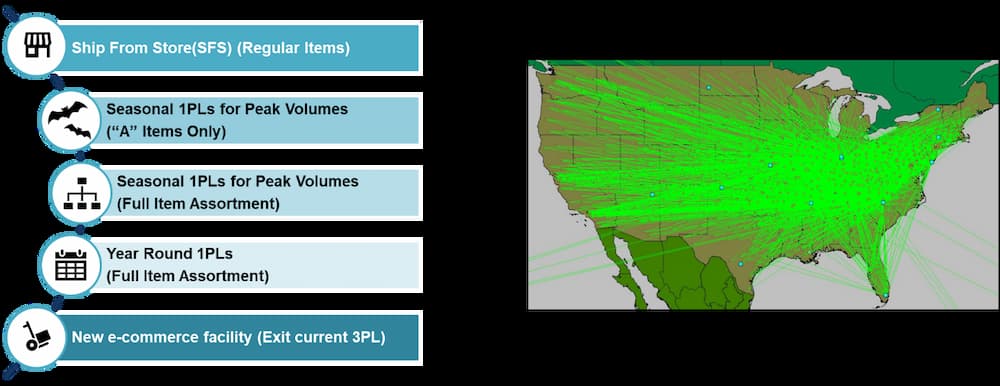
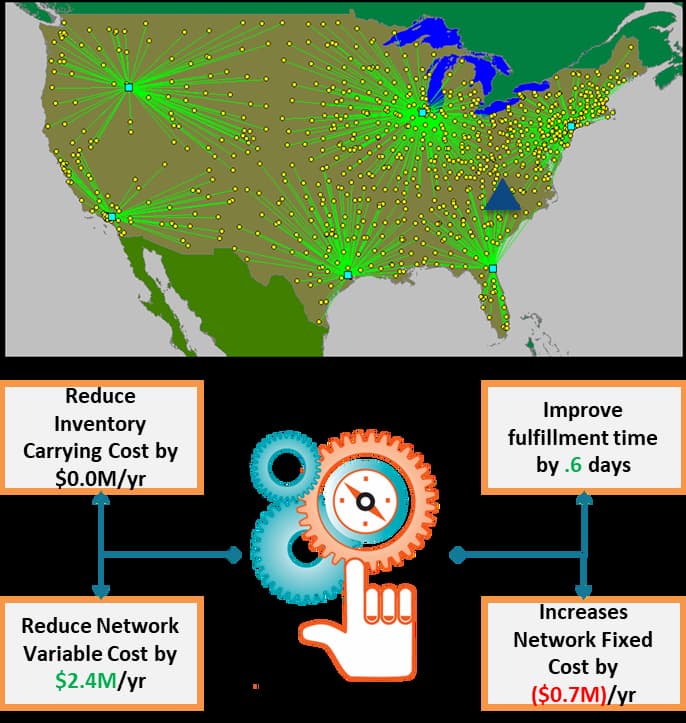
enVista has worked with many leading retailers, manufacturers and distributors to design an optimal supply chain network.
As these images show, before optimization, many retail networks suffer from inefficiencies such as redundant facilities, long transit times and fragmented data. After optimization, networks should be leaner, more synchronized and more customer-focused. e, see the before and after images below from a supply chain network analysis project.
Be Informed and Be Prepared
Retailers that thrive today continually reassess and refine their supply chain networks. Optimization isn’t a one-time project — it’s a philosophy of continuous improvement.
Whether you’re expanding into a new market, integrating a new brand or scaling your business, supply chain network optimization is crucial. Even relatively stable companies can benefit from a supply chain network optimization to maintain their competitive advantage. Partner with enVista to uncover hidden opportunities, reduce costs and build a supply chain that’s ready for what’s next.
Contact us to learn more about enVista’s supply chain network optimization services and schedule your assessment today.