
By Alex Katsamberis, Manager, Consulting and Maneesh Sivadasan, Solutions Architect
Walk through any retail store or browse your favorite online shop, and you’ll start to notice a major shift that is taking hold in retail stores and ecommerce platforms. Look closer and you’ll see the influence of Artificial Intelligence (AI) weaving its way into nearly all aspects of the shopping experience. From smarter shelf management to those eerily accurate product recommendations on your social media feeds, AI is dramatically reshaping how retailers and consumers interact.
That said, with all the buzz surrounding AI, the real conversations we’re having with retailers are far more grounded. What our clients and partners really want to know is simple: What’s working? What tools are making a measurable impact in real retail businesses, not just in theory? How do you avoid chasing shiny objects and instead make smart, scalable investments?
enVista’s retail consultants spend a lot of time on the ground helping retailers take value-added steps, not just talk strategy. From these experiences, we’ve uncovered valuable insight into what’s working and what isn’t. Here are five AI trends that are having a meaningful impact in retail today and a forward look into how we see them developing into 2026.
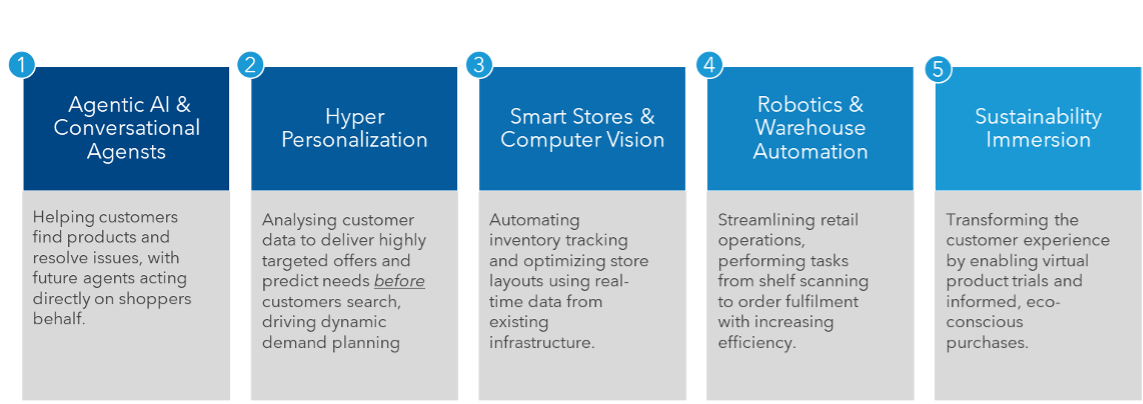
Agentic AI & Conversational Agents
Retailers aren’t just experimenting with AI anymore; they’ve been using it in their daily processes for quite some time now. Chatbots, recommendation engines and even tools that generate individualized email campaigns are already hard at work behind the scenes. In 2025, there is a very good chance you interacted with Amazon’s Rufus or Walmart’s Sparky. These tools are doing more than chatting; they’re actively improving the customer experience by helping people find what they need and resolving issues quickly.
From what we’ve seen, this shift isn’t slowing down. By the end of 2025, nearly half of major retailers will have had some kind of AI agent in play. For good reason, these tools are becoming increasingly indispensable.
What’s coming next is even more interesting. AI agents will begin moving beyond making suggestions to acting on behalf of shoppers. For example, imagine your digital assistant noticing you’re running low on coffee beans, shopping around for the best deal, negotiating the price and ordering it. This is the direction we’re heading in, and it requires tight integration across inventory, pricing and fulfillment systems. It’s a shift toward a more automated retail ecosystem, and it’s going to impact how we think about both customer service and operations.
Hyper-Personalization & Predictive Intent
Personalization in retail has moved far beyond broad customer segments and generic promotions. AI systems are analyzing browsing habits, buying patterns and engagement across multiple channels, serving up offers that are often so spot-on it feels like they read your mind.
What’s coming next, however, is a different level entirely. It’s enhanced personalization that anticipates what a customer wants before they even think to search. Instead of reacting to clicks and past purchases, predictive intent engines will use weather forecasts, regional events and major life milestones to surface the right product at the right moment in real time.
What that means for retail supply chain leaders is that demand planning must become more dynamic. It means syncing personalization engines with inventory in real time, while also creating a flexible IT infrastructure that can support localization and personalized product pushes while at scale.
Smart Stores and Computer Vision
We’ve all heard of the “smart home”. Now we’re starting to see the “smart store” change retail. We’re now seeing real, measurable gains from technologies like computer vision and edge computing. Systems like Amazon’s Just Walk Out eliminate the checkout process entirely, using cameras and sensors to track purchases as customers simply grab and go. On the back end, shelf-scanning robots like Simbe’s Tally or Focal Systems’ Shelf AI are keeping inventory in check, reducing out-of-stocks without requiring manual audits.
What really stands out is how much value is being squeezed out of infrastructure that already exists. Even standard security cameras are being repurposed to generate real time insights about customer behavior, dwell times and traffic flow. This data is gold for AI-based planning systems when it comes to store layout optimization and workforce planning.
Looking forward, we’re heading toward a more widescale adoption of intelligent AI-driven ecosystems where orders are automatically rerouted, disruptions are predicted in advance and inventory decisions adapt in real time. Additional autonomous merchandising tools which adjust assortments by neighborhood and micro-factories, like Adidas’ SPEEDFACTORY that produce goods locally, lead us toward an agile, responsive supply chain that’s truly built for personalization at scale.
Robotics & Warehouse Automation
If you’ve spent time in a warehouse or on a retail floor lately, you’ve probably noticed the sheer amount of robotics. They’re here, and they’re doing real work. From scanning shelves and building pallets to cleaning floors, automation is already creating measurable efficiency.
At enVista, we’ve seen this firsthand with our enMotion™ Robotics platform, which coordinates fleets of autonomous mobile robots (AMRs), cobots and goods-to-person systems in the distribution center. The impact is operationally significant for retailers.
What’s next? Beyond predictable activities such as item scanning, robotics will perform complex tasks and deliver orders just as efficiently as their human counterparts. Some will be customer-facing, adding new dynamics to in-store experiences. With AI connecting robots to inventory and pricing systems, fulfillment will become faster, more responsive and smarter.
In one recent project, deployment of LiDAR-guided enMotion cobots cut travel and search time by nearly 80%. This is a game-changer in high-volume, high-velocity environments like retail distribution centers. With the retail automation market projected to hit $72 billion by 2034, it’s clear this isn’t a temporary trend.
Immersive & Sustainable Experiences
Digital experiences aren’t just “nice to have” in retail; they’re expected. Augmented and mixed reality are now making it possible for shoppers to see how a couch looks in their living room, try on glasses virtually or navigate a store through digital overlays. These tools are driving more confident purchases and reducing returns, which, as any supply chain pro knows, is a huge win.
Some retailers are going even further to incorporate these tools into sustainability efforts. Interactive signage, packaging that reveals deeper product info, embedded sustainability stats, carbon footprint, materials sourcing and so on, will all drive future shopping behavior. It’s a response to a very real demand for brands to be more transparent and accountable.
Looking ahead, we’ll see this immersive tech blend with sustainability in ways that measurably influence customers’ buying decisions. Shoppers will scan a label and instantly see a product’s environmental journey: where it was made, how it was sourced and what it costs the planet. Checkout screens will surface live carbon and ethical-sourcing scores. On the back end, retailers will lean hard on shared data platforms and advanced analytics to track, measure and reduce waste across their supply chains.
Bottom line: the brands that manage to combine transparency with a compelling, technology-rich experience are going to win the next generation of loyal customers.
Boots on the Ground: Lessons from the Field
Harnessed together, these five trends will substantially improve both top-line revenue growth and bottom-line efficiency, but none of it matters if you can’t assess, implement and execute across your retail organization. Here are some quick tips that have helped our retail clients get more out of their AI investments.
Start small. Scale fast.
The retailers seeing the best results are foregoing massive overhauls for “bolt on” modular AI solutions that augment their existing systems. Whether it’s demand forecasting or labor planning, focused pilots can prove value in a matter of weeks without disrupting daily operations.
Our advice is to start with your biggest product or customer category; the more complexity and visibility, the better the learning curve.
Data is everything.
If your product or supply chain data is messy or out of sync, AI won’t fix it, it’ll just make the cracks more obvious. Clean, real-time data is the foundation. It’s worth investing in the unglamorous work of aligning systems, standardizing inputs and automating where possible. The payoff is huge.
Don’t forget your people.
Change management is where most projects succeed or stall. Even the best tech fails without buy-in. Teams need to understand why the shift is happening, see early wins and view AI not as a threat but as a tool to help them do their jobs better. The goal isn’t to replace talent, it’s to free it up for more strategic work.
How enVista Can Help
Want to know how AI can deliver value for your business both today and tomorrow? Contact enVista’s retail consultants for a conversation. Together, we’ll make your operations smarter, your stores more efficient and your customers more loyal.